Showing posts with label Kenneth Branagh. Show all posts

Friday, October 14, 2011

As I Understand It. . .

Ok. . . I lied. I don't. Sure, the plot makes sense, the characters, although a little too quick to marry, are not exactly an enigma. But. . .in reading the play, and watching the different film versions, the why is a little fuzzy.

So. . .I guess I'll start with a discussion of the only film version that didn't take serious dedication to get through; namely, Kenneth Branagh's 2006 version.

He did a lot of interesting things in this film - most of which I liked, a few which I question.

The first was the setting; Branagh chose 19th century fuedal Japan for this, where the main characters are aristocratic British merchants building up their little empires in the foreign land. It sounds a little strange and off-beat at first, but it lends itself to the story surprisingly well. Besides, I think it embodies a sort of exotic, far off places Shakespeare so often liked to set his plays, and I think he would have approved. The stunningly colorful location undoubtedly enhanced the romantic sentiments. Not to mention, certain elements of the culture added a fresh twist to the storyline; the wrestling match between hired-muscle "Charles" and Orlando is turned into a Sumo-wrestling match, the overthrow of the Duke is carried out by a league of Samurai warriors, and Orlando's poems fill the tree like leaves instead of merely being tacked on.
Norm Lewis as Javert

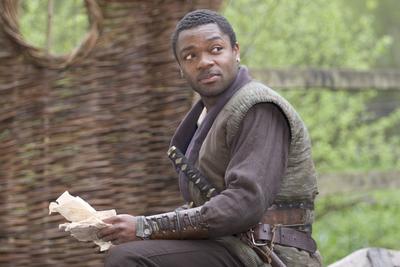
David Oyelowo as Orlando
Another interesting thing Branagh chose to do was to have a colorblind cast, at least in the case of Oliver and Orlando. As far as I know, the odds of two black men having a high rank in society as these two did in this time frame was unlikely, unheard of even. However. . .it didn't bother me much. Perhaps there is some historical exception in fuedal Japan, but it didn't matter. The actors he chose were phenomenal in their roles (and, as brothers, at least they were the same race, so it was at least realistic in that sense). It reminded me of watching the 25th Anniversary Les Miserables concert, where the actor portraying Javert, (who also, historically, probably would not have been) was black. But once again. . .I could care less, because, as with As You Like It, he was AMAZING. 'Nuff said!
Nick Jonas. . .nothing more than a pretty boy

Oddly enough, this same cast Les Miserables featured Nick Jonas as Marius. After watching his performance, I was a little nausiated and concluded he was only chosen to attract the interest of adolescent girls who wouldn't notice the obvious, extremely out-of-place pop vocal styles that the poor sap couldn't shake off long enough to do some real singing for one measely concert.  To me, sometimes, it's better to have decent talent than to be true to historical accuracy. (Well. . .okay, I'm not saying he's a bad singer, but he didn't perform correctly. . . if that makes sense. I hated his performance).

This is when Rosalind is supposed to be "Ganymede". . .
are you fooled? I'm not. But if Orlando actually is,
 than this scene would be even more awkward
than it already is . . .
Which leads me into the things I didn't enjoy about this film. Rosalind and Celia. . .much like Nick Jonas. . .chosen for their extreme beauty and ability in one respect. . . but negligent in some other necessary abilities. True, Rosalind was great at playing her female role. But nothing changed when she became a man. She didn't try to sound like a man, and, quite honestly, she looked every bit like a girl in trousers. A fake beard at least would have helped. No one, realistically, would have been fooled, least of all Orlando, one who has her image on his mind frequently.

I wonder if it was specific choice of Branagh's, to try to ease the transition of them falling in love so it wasn't so sudden. . .if Orlando sort of knew it was her. . . at least that's what I want to believe, because he was coming on pretty strong to "Ganymede," and otherwise that bit would come off as something entirely different.

The other was that ridiculous ending. . .after the wedding, they broke out into this confusing dance number, which wasn't really befitting of the time or place. . .and VERY heavy on vocals. And the odd thing was, sometimes the actors would try to mouth the words like it was they were singing, and sometimes not. . .leaving me confused. I remember watching this same movie a few years ago, and bursting out into uncontrollable laughter when that number started up. . .that part needed help.

And, as mentioned, I am still at a loss as to why Shakespeare wrote this. Perhaps, I need to re-evaluate my thinking and ask different questions. . .

But, interestingly enough, as I was searching for pictures to add to this post, I came across this blog:
http://shawnandshakespeare.blogspot.com/2010/10/as-you-like-it-2006.html
Perhaps some new insight will come of it? After all, he's pretty much got an archive of posts on almost every Shakespeare play there is. Maybe he can help with yours too. . .

Tuesday, September 13, 2011

Hamlet. . . some recurring themes


I suppose, since were already nearly done with Hamlet, that I'll just breifly touch on some of the major recurring themes I've noticed thus far, most of which were discussed in class last week.
The first is dreams. . . Hamlet brings dreams up a lot, comparing it to death; good dreams to heaven, rest, and piece, and nightmares to hell and damnation. The most prevalant example of this, of course, is in his famous "To be or not to be" speech.
 " To die: to sleep; No more; and by a sleep to say we end The heart-ache and the thousand natural shocks that flesh is heir to; 'tis a consummation devoutly to be wish'd. To die, to sleep; perchance to dream. Ay, there's the rub; for in that sleep of death what dreams may come, when we have shuffled off this mortal coil, must give us pause- there's the respect that makes calamity of so long life. For who would bear the whips and scorns of time. . . .but that the dread of something after death. . .makes us rather bear those ills we have to than to fly to others that we know not of?"
This makes me think of the mindset he must have been in at this time, with his son passing away just prior to his writing this. . . clearly, death was a subject he put much thought into.
Kenneth Branagh as Hamlet  - You might recognize him as
Professor Lockhart from Harry Potter. He's one of my
favorite actors, and reminds me a lot of Brian Vaugn, an
actor who is in many productions each year at the Utah
Shakespearean Festival. . . maybe we'll get to see him
in the Winter's Tale!
The next is daggers entering the ear. . .obviously a reference to the particular way in which Hamlet Sr. was murdered. The most curious reference I think is when Hamlets mother brings it up as he's chastising her for being so hasty to marry his Uncle. . it almost makes me wonder if she had more to do with her father's death than is apparent (even if it was just encouraging him. . . something to ponder.)
Another is the idea of Fortune as a whore. I think this is just Hamlet showing more angst against his mother, who seems to have acted as Fortune because she seems to be making most of the decisions. . .and in his eyes, a whore for being so hasty to remarry. Harsh? Maybe. Understandable that he feels that way? Completely.
Finally, probably the most common theme discussed is whether or not Hamlet is acting most of the time, and when he is and isn't. . . honestly, I have a hard time coming up with an answer; I hang out with a lot of actors, and to be perfectly honest I can't even tell when THEY are being serious. . . so that still remains a mystery to me.